Melissa Ashley Hernandez
June 14th, 2023
Lexi Everland is a professional fire spinner and wildland firefighter, among many other things. She has been performing for a little over 5 years but has been practicing for about 10. For Lexi, it is hard to find the time to balance a very demanding full-time job and performing, but not impossible! She aspires to inspire the creative who is balancing their love of their art and a full-time job.
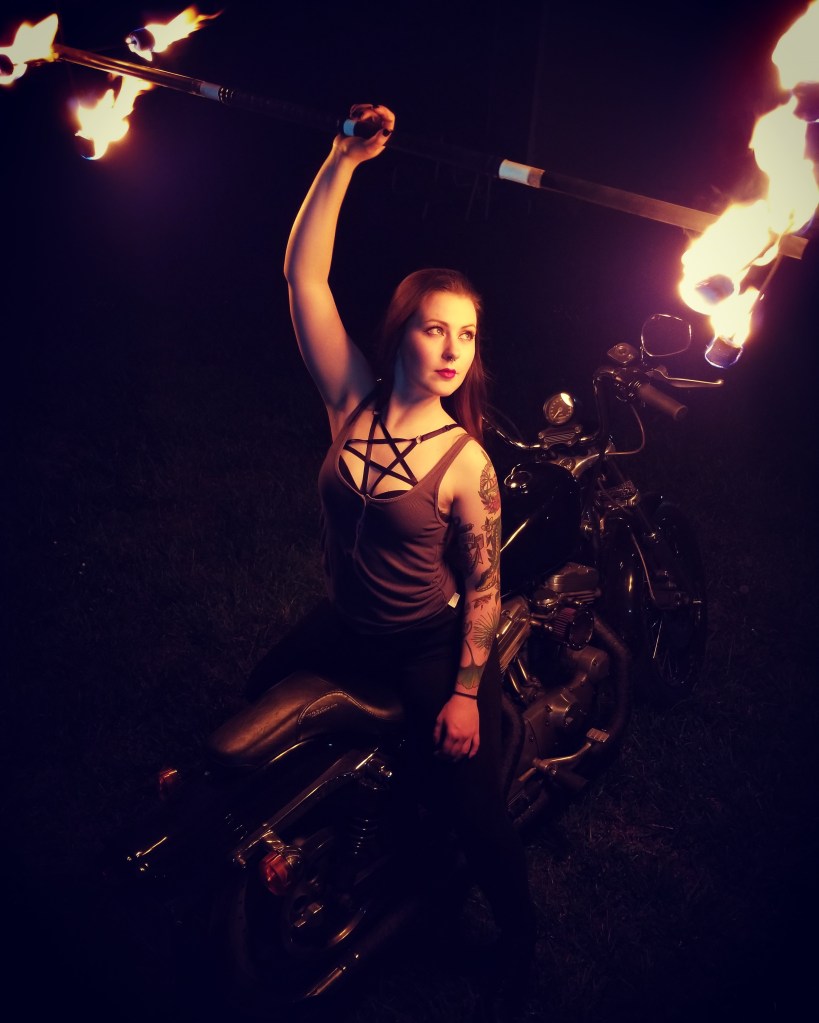
Lexi is a long-time lover of fire. This love has brought her down many related paths in life, including learning how to perform fire spinning, dancing, and performing, and securing a job as a New Jersey Wildlands Firefighter.
Performing for a living is a dream not many are able to realize, so, like many creatives, performers have to balance booking performances with the realities of everyday life. In this interview, Lexi talks about her love for fire performance, the balancing act of having a more demanding job while trying to maintain your creative outlets, and advice on how to begin the foray into fire arts!
(Read the Carnival issue here!)
Interview with Lexi Everland
TMP: Fire Spinning. Wow! Of all the skills to pursue, how did you choose that one? How did it start?
LE: Well, I’ve tried out many many hobbies but this one really stuck! I went through phases where my artistic expression showed itself as jewelry making, painting, drawing, and even writing – but this one allowed me to move my body while expressing myself, and also showcase the hard work I put into my performances. Sometimes I even get to make money by doing it! And the work I put in to get good enough to not burn myself and feel confident performing didn’t feel difficult at all. Before I realized it, years had gone by and I had gotten pretty good, and I had kind of forgotten all the hours I put into it. I think that’s just because I love doing it so much, and it offers me an amazing outlet so it didn’t feel like work at all.
TMP: In our previous conversations, you’ve mentioned other skills, hula hooping, aerial performance, acroyoga — have you ever married any of those skills with your fire spinning?
LE: Yes! I have. A fire hula hoop is one of the many fire props I use and probably the one I am most proficient at. It is also where my love for the art really started. My performing partner and I will also throw in a couple basic acroyoga moves into an act, which is sort of like partner acrobatics.
TMP: What was the biggest struggle when learning how to fire spin?
LE: I would say the biggest struggle was lighting my fire prop on fire for the very first time. I practiced for quite a while without the wicks lit until one day I said, I think I’m ready. And my brother was there as my “safety,” a term we use to describe the person usually standing off stage with a towel or fire resistant duvaline cloth just in case we catch something (or ourselves) on fire. I guess it was mostly getting over the fear of getting burned. And I’m not going to say that you don’t get burned while performing: you take the proper precautions, wear the proper clothing (natural fibers because synthetics melt to your skin, fire resistant material, and/or fire resisting spray), but you still frequently get burned. But that’s the nature of the art. Hey, if you play with fire, you are going to get burned! But if you are well practiced, the burns are usually very minor and almost feel like a small patch of sunburn. Sometimes you may mess up, and then they’re a little more than a sun burn, but over time and with much practice and many mistakes, you fear getting burned less and less and less and you get better and better and better. I feel it’s a great analogy for life in that way.
TMP: Is there a fire skill you prefer? Do you have a favorite prop you like to use?
LE: I certainly have my go-to props, and the fire hoop is the one I have practiced the most, but I love them all for different reasons. There’s almost a completely different flow to each one. Some have similar moves that translate, but overall it’s almost like playing completely different instruments associated with completely different genres of music. Sometimes I am just in the mood for my dragon staff, which is a long staff with four wicks at either end that you manipulate by rolling down your arms and body and legs for the most part. And sometimes a different song will come on my playlist and it’s a song I just HAVE to pick up my fire fans and groove to. There’s also a common philosophy in the fire-spinning world that certain props are similar to dancing with a partner, like the fire hoop, dragon staff, contact staff, etc. The prop moves around you and you move around it. While other props are like extensions of yourself while you dance, like fire fans, double hoops, buugeng, etc. The props accentuate your movement. So it depends on whatever I’m in the mood for!
TMP: What was the hardest trick for you to learn, and what is the hardest trick for you to perform?
LE: Currently, the hardest tricks for me to learn are anything with my fire dart. Which is a large ball-shaped wick attached to a very long rope. It is so hard for me, and takes me the most time when learning tricks because it is a prop not like any other prop I have used before. The flow is different, the way you move your body in relation to the prop is different, the footwork is different, the parts of your body you use to manipulate the prop are different. And therefore, it is also the hardest for me to perform.
TMP: Pyro Noir Productions. Let’s talk about it: what is it? How did it start? Where do you want it to go?
LE: Pyro Noir Productions is a performance group based in South Jersey specializing in fire performing that my best friend and I started when we both had more time on our hands to book gigs. For a while there, we were booking gigs every other weekend around our normal jobs during the spring and summer and had a lot of fun! We performed at local festivals, car shows, bike shows, backyard BBQs, birthdays, weddings, and even at bars while bands were playing. Then Covid hit and we couldn’t perform for quite a while. Then we both got really busy with our jobs but we are looking forward to hopping back into the groove soon!
TMP: So, you work as a New Jersey Wildland Firefighter now — how did you make the leap from starting fires to putting them out?
LE: I guess my affinity for fire manifested itself in a couple ways! Fire spinning came first, and probably did influence my decision to take a career in fire. Since graduating high school, I knew I wanted to work outdoors in the environmental field. I went to school for environmental sciences and began taking the forestry route. It was then that I learned about the field of wildland firefighting. Initially I started out in the research realm, and then made the transition into the operational side where instead of studying wildland fire and its effects, I now get to fight fires and sometimes light them for prescribed burning purposes! From dancing with, to studying, to fighting and lighting, I can say I have come to intimately know the nature of fire. This reaffirms just how amazing a phenomenon it is, making it even more exciting to me.
TMP: A lot of our readers are creatives, not unlike you, attempting to make their creative life work with the reality of their everyday. Do you have any advice on how to manage that balancing act?
LE: It is HARD! Especially when you are passionate about both. At times, one will overtake the other. For the past two years, I haven’t gotten to perform much at all because of my new job. But things will slow down soon, and I will be able to get back into it eventually, and that is okay. I still practice at home when I get the chance and it serves as such a great stress reliever! It helps ground me and reminds me of why I do what I do. It gives me a moment to myself, to slow down, to move my body, to express my emotions, to feel my emotions, to process, to create! And that keeps me going at my other job. Especially when my other job gets hard, when it hasn’t rained for weeks, it’s dry as hell, and fires are happening left and right. It helps soothe the fires in my own life. And I feel like that’s why creatives create! So you have to make time for it. It’s how we self-care.
TMP: Any tips for beginners wanting to get into fire spinning?
LE: Yes! I would say buy a prop you are interested in and spend a lot of time with it UNLIT. You will most likely have to begin your search for a prop online. Watch a ton of YouTube videos to figure out which props you are interested in (you will probably have to order them online.) And then watch a ton more YouTube videos to learn how to move with the prop. There’s a bit of a learning curve, so don’t get discouraged! But also, don’t be afraid to try another prop. Certain ones might just click for you. There is also a huge fire-spinning community in the country, and the world! Connect with them! There are groups on Facebook and Instagram, find local ones, find out where they meet for spin jams, and just show up! You will learn a lot from watching people, and they are also always more than happy to teach.
TMP: Anything I haven’t asked that you want to talk about?
LE: As much as I love my full-time job, it does make it very hard for me to spend as much time practicing and performing as I would like. It’s so very hard to find a balance. Part of me thinks that If I could make performing my full-time job, I wouldn’t work a day in my life. The other part recognizes the reality of what it would take to do performing full-time. Probably gigs every weekend and a lot of scouting for gigs at first. A lot of marketing, maybe getting into teaching fire spinning. Maybe traveling the country hosting workshops. Probably a lot of time spent content-creating, which does sound amazing. But after some time, I know it would become mundane at times, and become a job like any other job. I like not having to sell my art. Not having to sell my creativity. I wish I could spend more time doing it, and hopefully I will be able to. The ideal balance is probably different for everybody, and maybe so worth it for other people to put the work in to make it a full-time job. And some would probably rather have a bad day doing what they love, than a good day doing anything else. But for those like me, with so many different passions and hobbies, I think it’s okay to not have to sell your art and to do it purely just for you.
FIRE SPINNING LIGHTNING ROUND:
Question: Favorite genre of music to perform to?
LE: it really depends on whatever I am in the mood for. Sometimes it’s really techy stuff if I want to move fast. Sometimes it’s soulful music if I want to move with intensity and passion. Sometimes it’s reggae or jam bands if I want to just flow like the wind!
Q: What was your favorite costume?
LE: So all of our costumes have to be fire-resistant and very unrestrictive, and that can make costume creation a little tough. But putting together a theme-specific costume is another aspect I truly enjoy about performing. Halloween events are always fun because you can get really creative. Circus clown costumes are super fitting and usually allow a great deal of movement. But I think my favorite costume so far was this skeleton catsuit with skull face paint. The material was so flexible and comfortable, and painting the skull face was fun!
Q: Biggest inspirations in the industry?
LE: My biggest inspirations in the industry were definitely my friends in the industry that introduced me, the local community I was lucky to have access to, as well as very influential content creators online.
Q: Most challenging/uncommon place you’ve performed?
LE: I’ve performed in very tight spaces and on very small stages. But the most challenging is when it’s hot out, and you’re on asphalt, and the sun is cooking you and so are the flames! Just have to remember to hydrate and take breaks.
Q: What has been your most memorable or unique performance experience so far?
LE: My most memorable experience performing so far was performing for the first time in front of a very large crowd, probably over 2000 people. I was surprised how much the crowd watching me didn’t matter and just melted away into the background. The flames sort of blind you from the crowd and you feel like it’s just you and your prop. And every now and then when you nail a tough or visually appealing trick you hear the crowd cheer and clap and whistle.
A big thank you to Lexi for allowing us such a wonderful interview! If you’d like to support her, you can visit Pyro Noir Productions website, or follow them on Instagram.
 Wild Willow Magazine